Sailing the Saronic Gulf › Hydra
Sailing Hydra
A stone amphitheatre of a harbour, mansions built by sea captains, and an island where the only traffic is donkeys and water taxis. Hydra was made to be arrived at by boat.
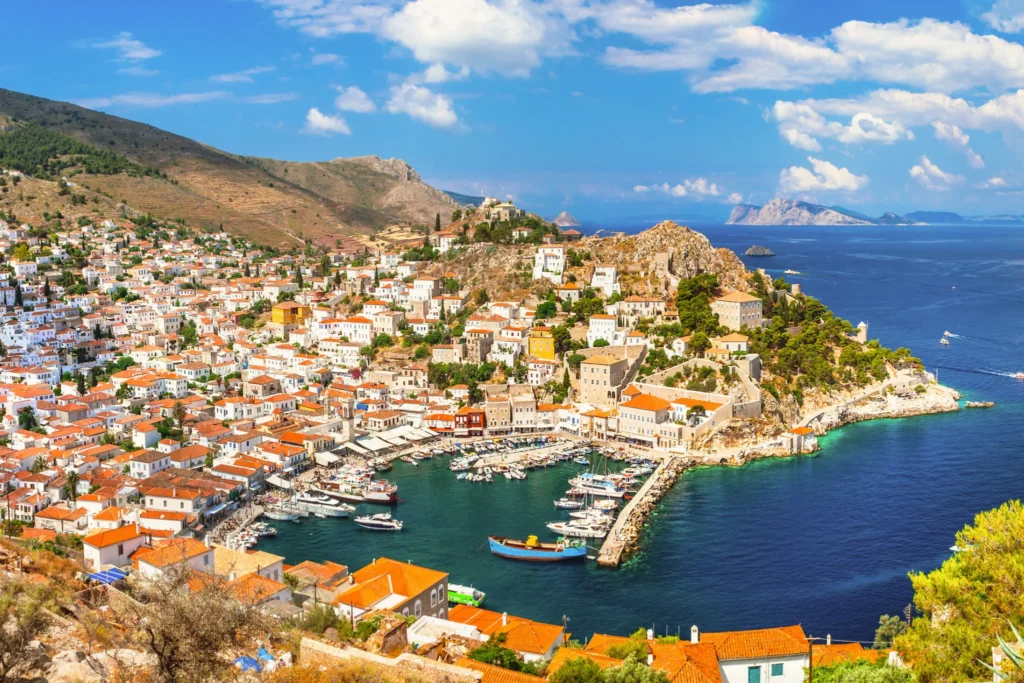
Hydra harbour, with the stone houses climbing the hillside.
Hydra at a glance
From Poros: about 8–10 nautical miles, a morning’s sail
Best season: May to October
Wind: the harbour is open to the north
How long: 1–2 nights
Hydra is a long, bare ridge of rock with one town, and the town is the reason everyone comes. Grey stone mansions climb the hillside round a small, round harbour, built in the 18th and 19th centuries by shipowners who made the island rich. Nothing has been allowed to spoil it since. There are no cars and no roads, so goods, luggage and building materials still move by donkey.
The rest of the island is quiet: a few small bays along the north coast, monasteries high on the mountain, and footpaths that run along the shore and up into the hills. The famous evening on the harbour front is real, but so is the silence ten minutes’ walk away.
“Hydra is the one place where I tell guests to arrive by boat, not by ferry. The harbour opens up in front of you and the whole town is looking at you.”
— Vaggelis, Punto Voyage
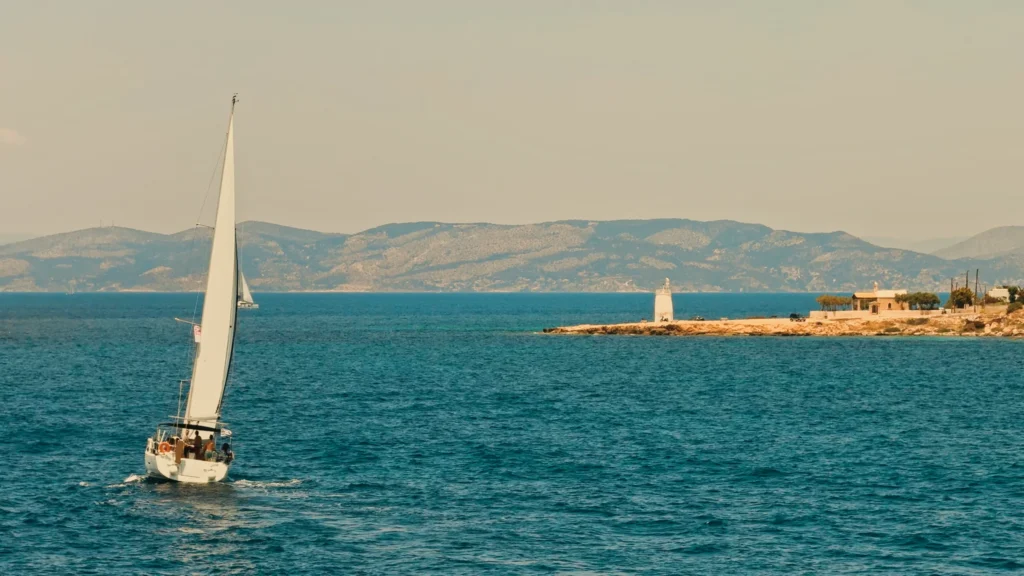
Sailing past a lighthouse in the late afternoon, on the way through the Saronic Gulf.
Harbour and anchorages
Hydra is about 11 nautical miles long, and almost everything you need for a night lies along the sheltered north coast.
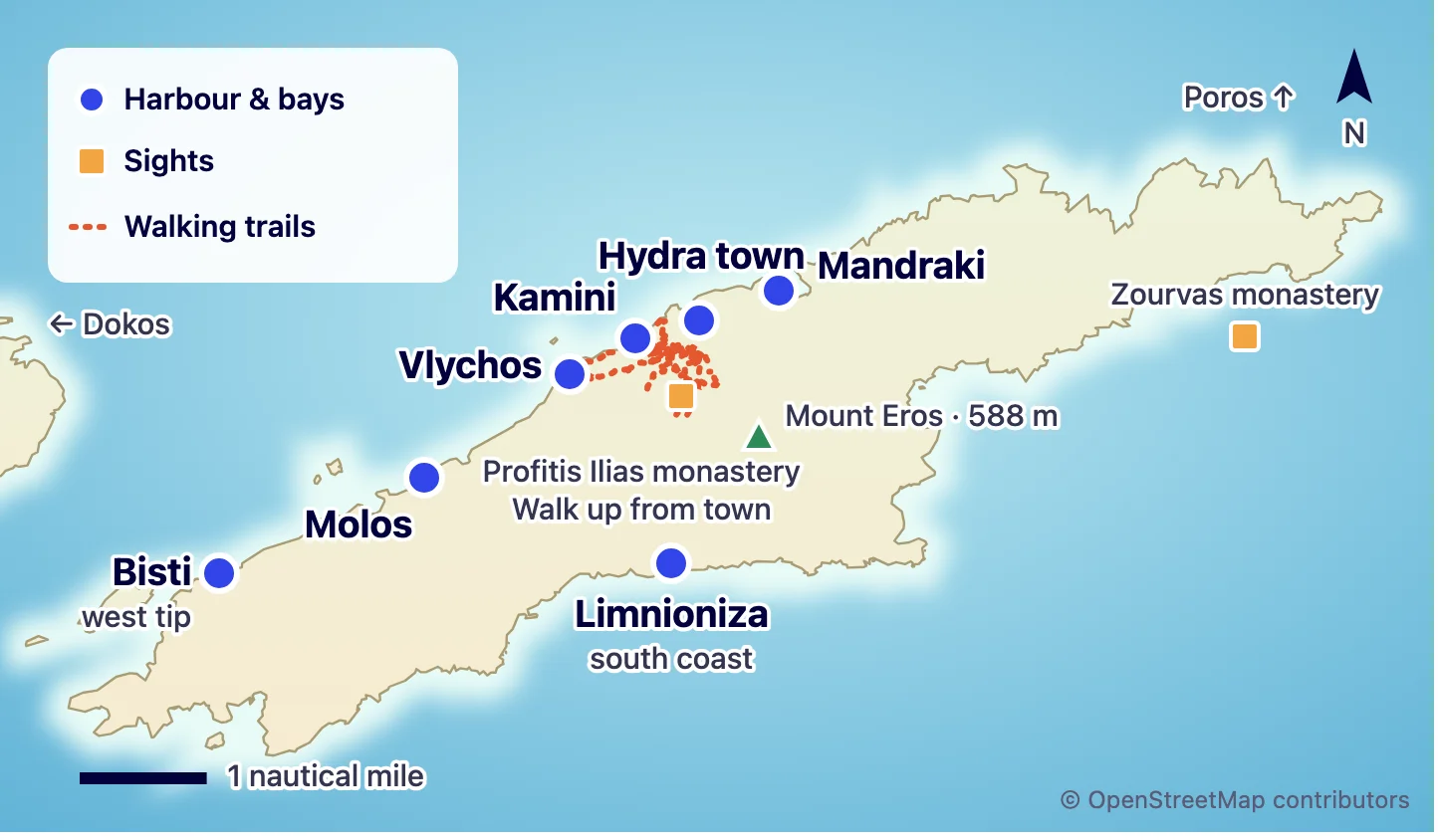
The harbour and bays in blue, sights in orange, walking trails in red. Map data © OpenStreetMap contributors.
Hydra town
A small, deep harbour ringed by cafés, with yachts moored stern-to along the quay right in front of the town.
Skipper’s note: Very popular and very small. In summer boats raft up two and three deep, and swell comes in with a northerly. Arrive early, or anchor nearby and come into town by tender or water taxi.
Mandraki
The island’s old naval harbour, a short bay east of town with a beach.
Skipper’s note: The usual alternative when the town quay is full. About twenty minutes’ walk along the coast path to the harbour, or a short water-taxi ride.
Kamini
A tiny fishing harbour with tavernas on the water, a short walk west of town.
Skipper’s note: Too small for yachts. Anchor off in calm weather for lunch, or walk here from town in the evening.
Vlychos
A pebble beach with a couple of tavernas, and an old stone bridge across a dry stream behind it.
Skipper’s note: A good daytime anchorage in settled weather. Open to the north, so not a place to sleep when the meltemi blows.
Molos
A quiet bay further along the north coast, with a beach and very few people.
Skipper’s note: The quiet alternative when town is too much. A calm night here is one of the best of the week.
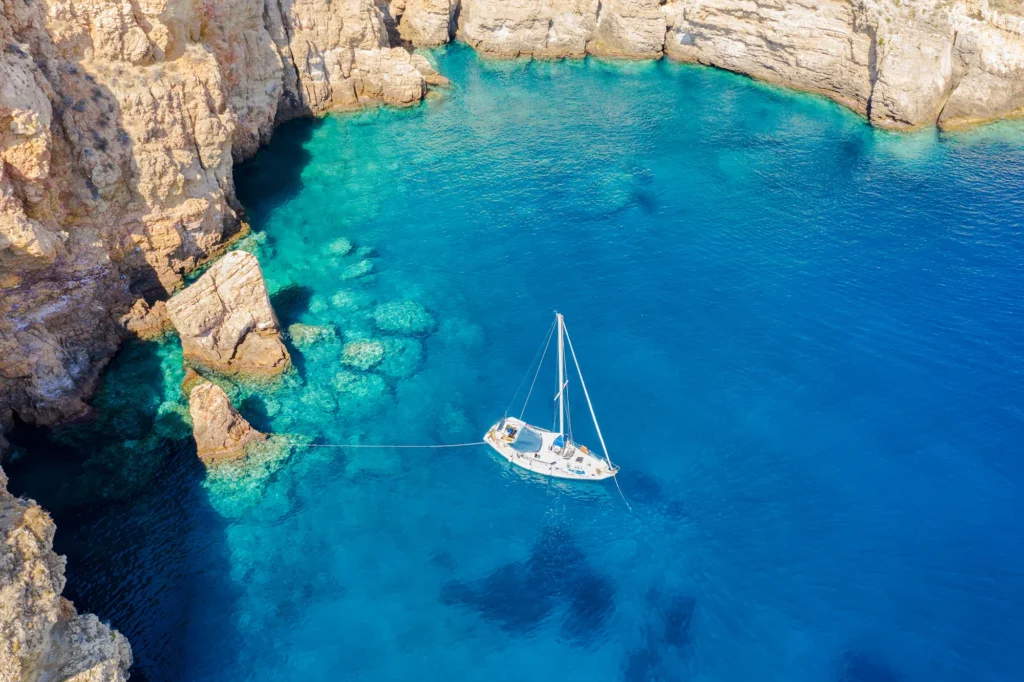
A sailboat alone in a clear cove: the kind of night Molos and Dokos are for.
Bisti
A pine-backed beach at the western end of the island, with very clear water.
Skipper’s note: A swim stop on the way in from Dokos or Spetses. Day boats arrive around midday, so come in the morning.
Dokos and Skintos bay
An almost empty island just west of Hydra, with a large bay on its north side. The seabed here holds one of the oldest known shipwrecks in the world, from around 2200 BC.
Skipper’s note: The classic overnight anchorage near Hydra: a handful of boats, no lights and a sky full of stars after the harbour crowds. Gusts can roll down the hills, so the anchor is set with care.
Things to do on Hydra
Sit on the harbour front
Coffee at a café table with the boats a few metres away. Early in the morning, before the day boats, the harbour belongs to the islanders.
Walk up to Profitis Ilias
About an hour and a half on a stone path through the pines to the monastery high above town, with the whole Saronic Gulf below you.
The coast path to Vlychos
A flat, easy walk west from town past Kamini to the beach at Vlychos. Swim, have lunch, and walk back or take the water taxi.
The captains’ mansions
The Lazaros Kountouriotis mansion and the Historical Archives Museum tell the story of the shipowners who built the town.
Swim off the rocks
Just past the harbour, the islanders’ swimming spot: ladders down from the rocks into deep, clear water, and a bar for afterwards.
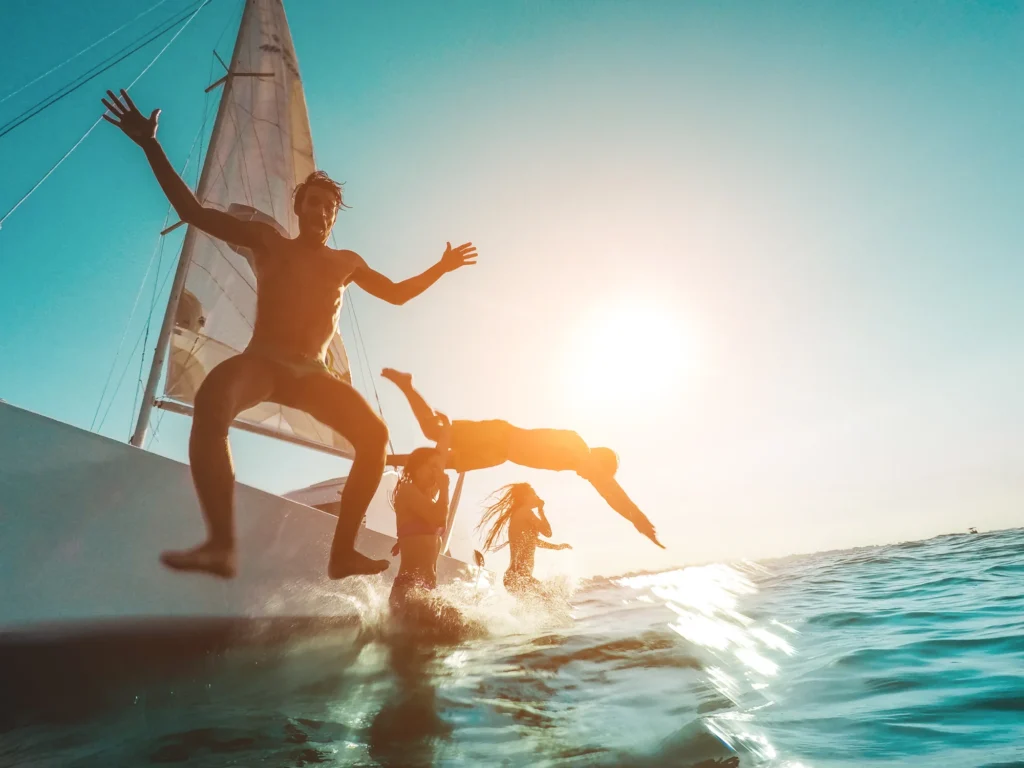
Straight off the boat and into the water.
Sunset on deck
Evening at anchor off Mandraki, with the town lights coming on across the water.

Sunset from the deck at anchor.
A day around Hydra
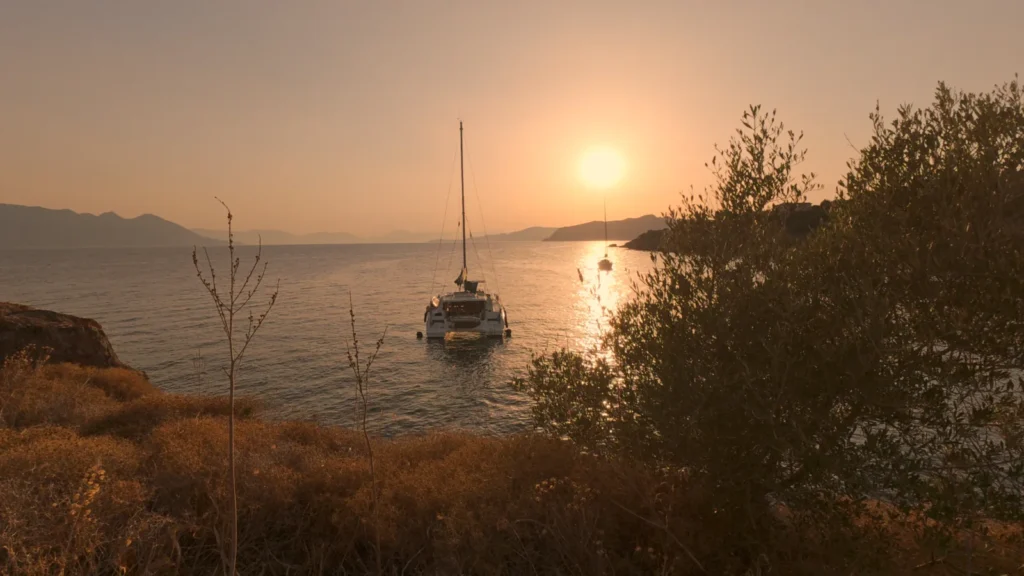
A quiet anchorage at sunset, away from the harbour crowds.
The morning starts at anchor in Mandraki. The water taxi takes you round to town while the harbour is still quiet: donkeys being loaded on the quay, the bakery open, the cafés putting out their chairs.
Late morning, the walkers set off for Profitis Ilias. The others take the coast path to Kamini and on to Vlychos, where the boat comes round to meet everyone for a swim and lunch.
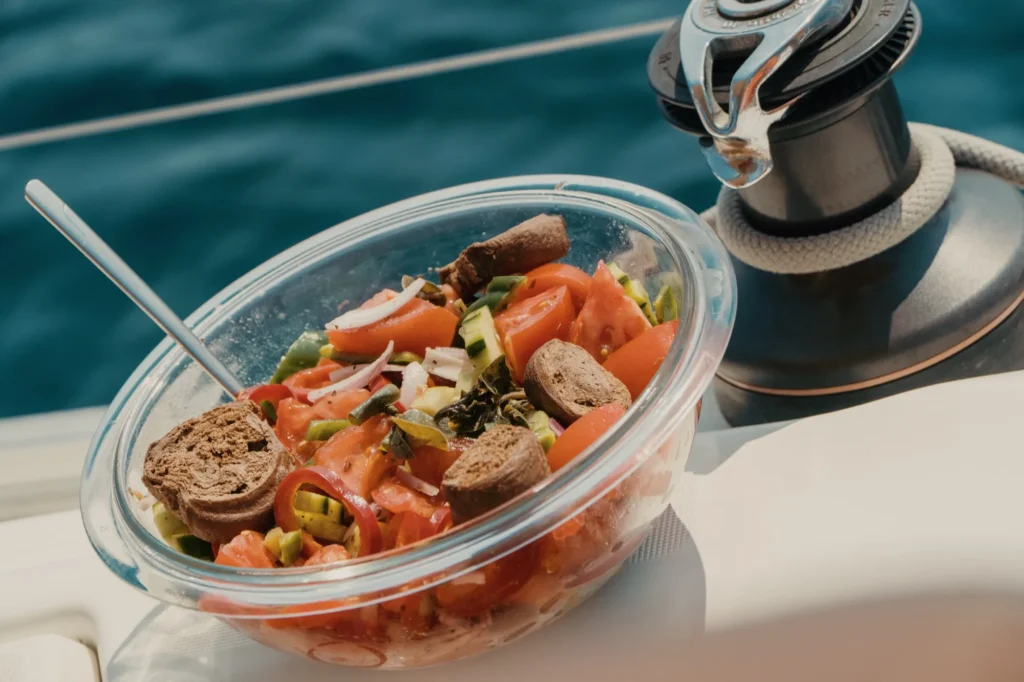
Lunch at anchor: a Greek salad on deck between swims.
In the afternoon you sail slowly along the north coast to Molos or out to Dokos, and drop the anchor in a bay with nobody in it. Or you go back into town, if the quay has space, and let the evening happen on the harbour front.
Tips before you sail
April – June. Light winds and green hills. The easiest months for the town quay. At the end of June the Miaoulia festival fills the harbour.
July – August. A busy harbour and meltemi days from the north. Plan around the wind and use Mandraki, Molos and Dokos.
September – October. Warm sea, a quieter town and calm evenings.
No cars. Everything moves on foot, by donkey or by water taxi. Bring shoes you can walk in on stone steps.
Provisioning. Small shops and a bakery near the harbour. Stock the boat in Poros, where it is easier.
Water taxis. Fast boats from the harbour to Mandraki, Kamini, Vlychos and the beaches. The easy way back after a walk.
Evenings. Book a table for dinner in July and August. The lanes behind the harbour are quieter than the front.
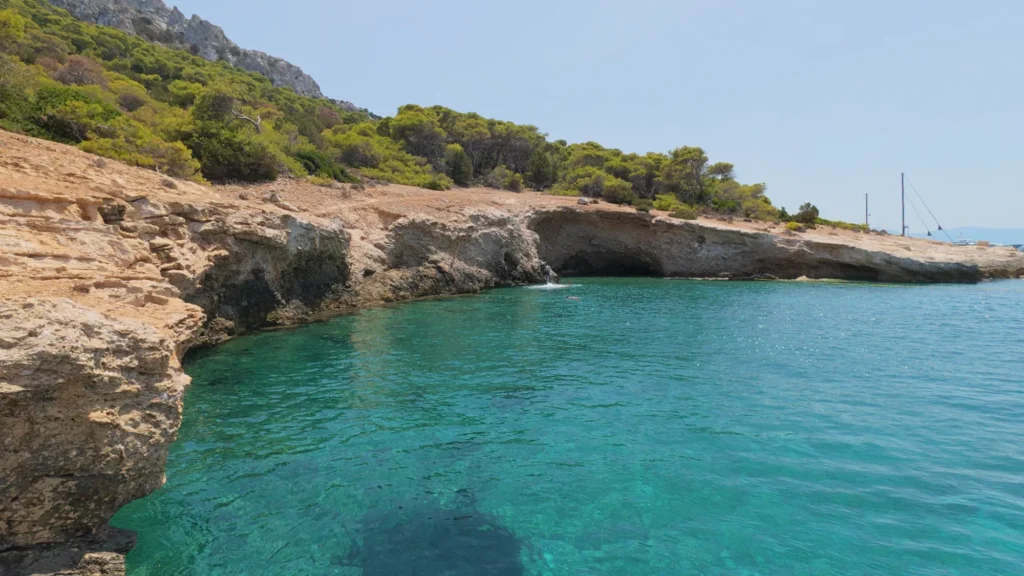
A rocky cove with turquoise water in the Saronic Gulf.
New to sailing? Coming with children?
Hydra is busy in the harbour but easy around it: short hops, calm bays on the north coast and a town you can visit by day.
Short hop. Poros to Hydra is a morning’s sail, with the Peloponnese on one side most of the way.
Choosing the night. If the harbour is rolly, sleep at anchor in a calm bay and visit town by day. You will not miss anything.
Children. Donkeys on the quay, water-taxi rides, the stone bridge at Vlychos and pebble beaches to throw stones from.
Getting ashore. In the harbour you step off the stern onto the quay. From the bays, the tender or a water taxi takes you in.
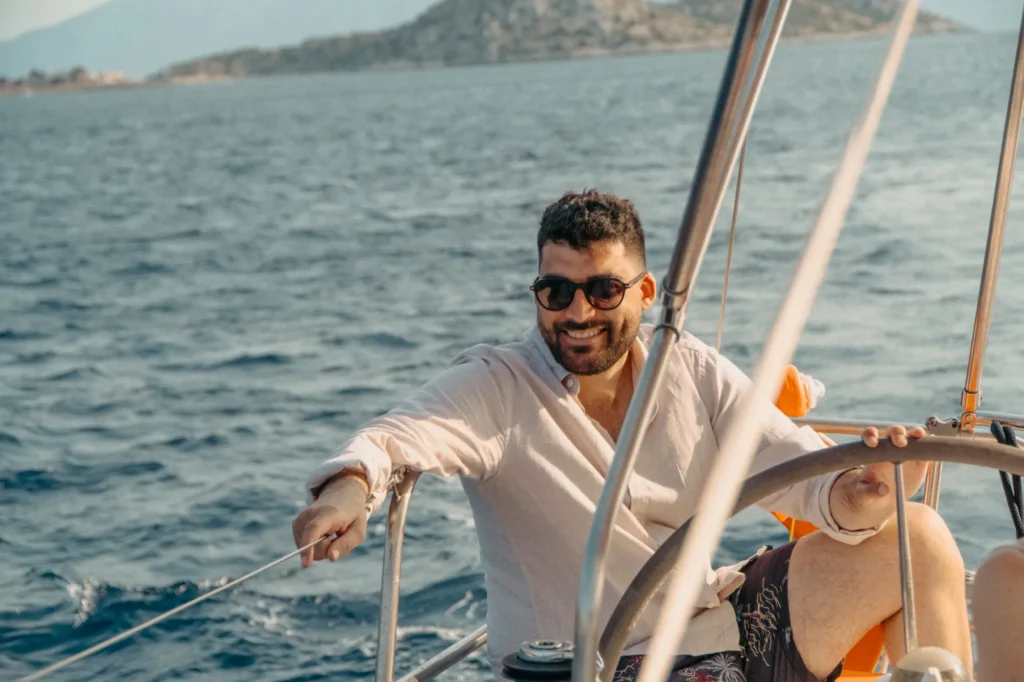
Everyone gets a turn at the wheel.
Combine Hydra with…
Hydra is the furthest point of a week in the Saronic Gulf, after Aegina, Palaia Epidavros and Poros. Some guests ask to go on to Dokos and Spetses before turning back. See the example Saronic week.
The stop before Hydra is Poros, with its narrow channel and pine bays. Read the Poros sailing guide.
For the whole picture, from Aegina to Hydra and Spetses, read my guide to sailing the Saronic Gulf.
Questions about sailing Hydra
How far is Hydra from Athens by sailboat?
About 38 nautical miles, too far for one comfortable day. On the Saronic week it comes after Aegina, Palaia Epidavros and Poros.
Can a sailboat moor in Hydra harbour?
Yes, stern-to on the quay, but space is limited and boats raft up in summer. Mandraki or Molos are good alternatives, with town a short walk or water-taxi ride away.
Where is the best anchorage near Hydra?
Mandraki for a night close to town, Molos for quiet, and Skintos bay on Dokos for a calm night under the stars.
Are there really no cars on Hydra?
None. Donkeys carry luggage and goods, and water taxis take people along the coast. It is a big part of why the island has stayed so beautiful.
Is Hydra good for families?
Yes, with a little planning. The harbour is busy, so choose calm bays for sleeping and go into town by day for the donkeys, the swimming rocks and the ice cream.
Arrive in Hydra the way it was meant to be seen
Tell me your dates and who is coming. I reply personally by email with a route, two or three boats and an indicative estimate.
Request a free proposalOr write to me at info@puntovoyage.com.