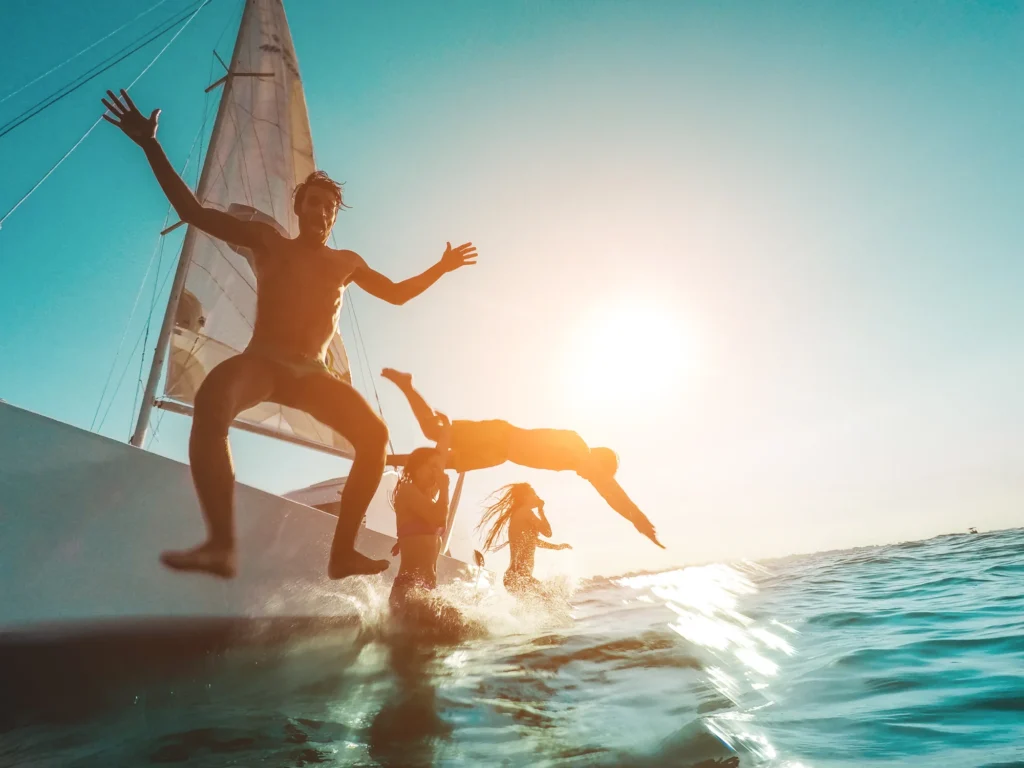
Yes, you can sail in Greece with children, and for many families it becomes a favourite holiday. The secret is choosing calm water, short sailing days and the right boat. Here is how to plan it.
Family sailing at a glance
Easiest areas: the Saronic Gulf and the Ionian Sea
Best months: June and September
Best boat for families: usually a catamaran
Sailing per day: 1–3 hours, then swimming and time ashore
Skipper: always on board, so you can be a parent and not crew
Children don’t need a long list of activities on a boat. The sea is the activity: jumping in from the stern, snorkelling over a rocky bottom, spotting fish, steering for a few minutes, and arriving at a new harbour every day. What they do need is a plan built around them, not around the miles.
Is sailing safe for children?
With a professional skipper, sensible distances and a few simple rules, a sailing holiday is a very safe way to travel. The skipper reads the weather, chooses sheltered anchorages and decides when to sail and when to stay put. Your job is to keep an eye on the little ones on deck.
Life jackets in the right size. Charter boats carry adult life jackets. Children’s sizes are usually available on request, so give the weight and age of each child when you book.
Safety netting. On many boats netting can be fitted along the guardrails. It is worth asking for with toddlers.
Simple deck rules. Life jacket on while sailing, no running on deck, and always hold on with one hand. Children learn these in a day.
Shade and water. The Greek sun is strong. Shade on deck (bimini), UV swim shirts and plenty of water matter as much as anything else.
Skipper’s note: With children on board, sail in the morning, before the afternoon wind picks up. By lunchtime you are at anchor, which is exactly when they want to swim anyway.
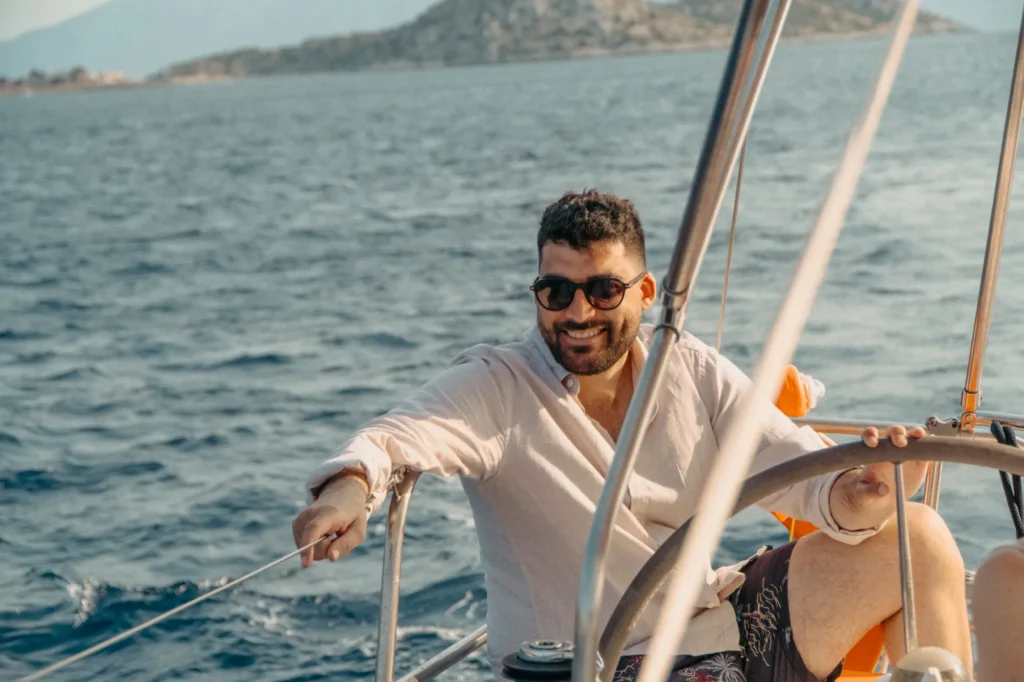
Everyone gets a turn at the wheel, with the skipper right next to them.
Which boat is best for a family?
For most families a catamaran is the easiest choice. It sails almost flat, so plates stay on the table and nobody has to hold on while walking around. There is far more space: a big cockpit for meals in the shade, nets at the front to lie on, and cabins in separate hulls, which helps when small children go to bed early. Catamarans also draw less water, so you can anchor closer to the beach.
A monohull works well with older children and teenagers who want to feel the boat heel and help with the sails. It is also the more budget-friendly option for a smaller family. There is a full comparison in Catamaran vs Monohull: which one should you choose?
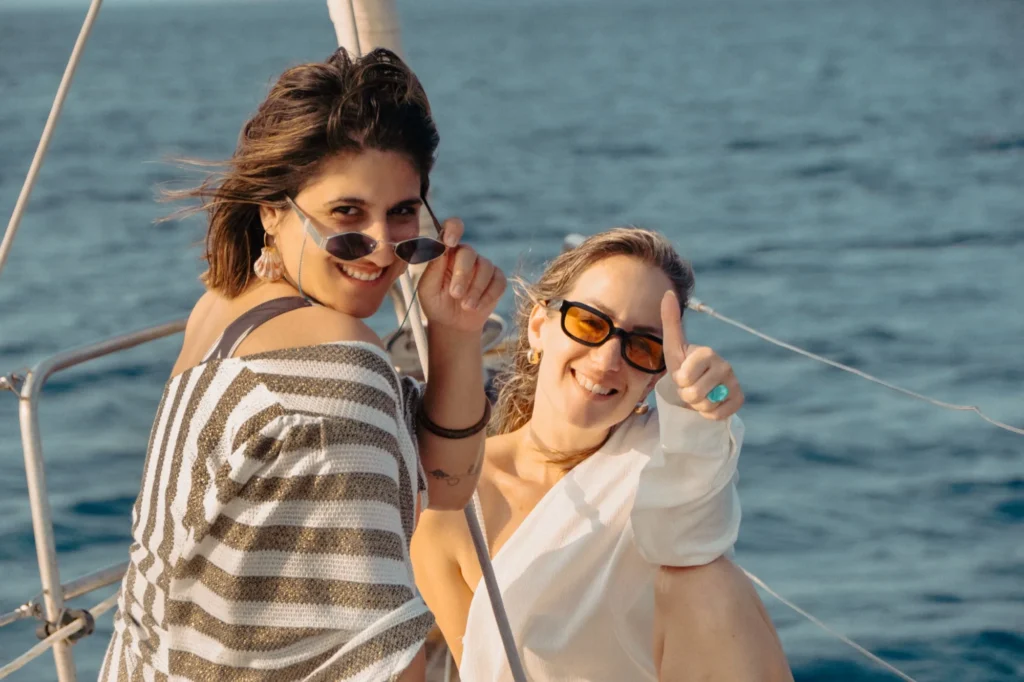
The bow is everyone’s favourite place to relax.
Where to sail in Greece with kids
The Saronic Gulf: close to Athens, short hops
The marinas for the Saronic are about an hour’s drive from Athens airport, distances between them are short, and harbours like Aegina and Poros let you step straight off the boat into town for an evening walk and an ice cream. Read the Aegina and Poros guides, or the whole Saronic Gulf sailing guide.
Skipper’s note: The channel at Poros and the bays on the west side of the island stay calm even on windy summer afternoons. For a first family trip it is hard to beat.
The Ionian Sea: green islands and calm mornings
Green hills, sheltered bays and gentle winds that usually build only in the afternoon. Paxos, Antipaxos and the coast of Lefkada are classics for families. See the Ionian sailing week.
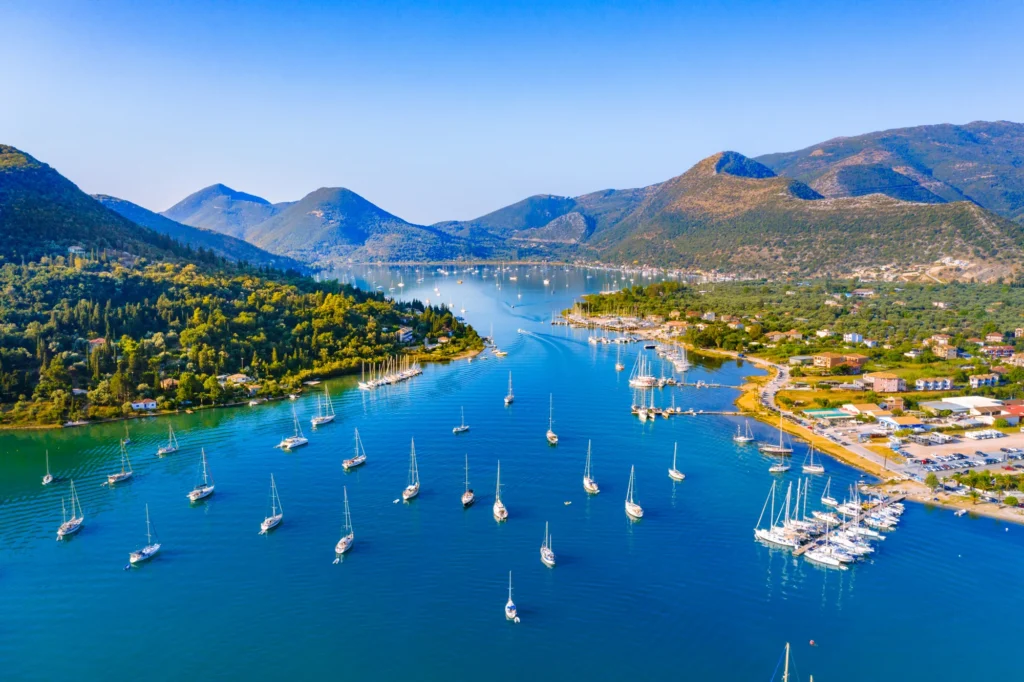
Sailboats at anchor in a bay near Lefkada, in the Ionian.
The Cyclades: for older children, in June or September
The Cyclades are spectacular, but in July and August the meltemi wind can blow hard for days and the crossings are longer. With teenagers, or outside high summer, they are wonderful. See the Cyclades sailing week.
When to go
June. Long days, warm enough to swim, fewer boats, and mostly settled weather. The best month for families if school holidays allow.
July and August. The hottest months and the busiest harbours. Choose sheltered areas (Saronic, Ionian), sail early and rest at midday.
September. The sea is still warm from the summer, the crowds thin out and the light is softer. Ideal for families with younger children.
What a day on board looks like
A morning swim before breakfast, still at anchor. Then a short sail to the next bay or island, with the children taking turns at the wheel or watching for dolphins. Lunch at anchor, a long swim, snorkelling, maybe a paddleboard if the boat has one. Late afternoon in a harbour town: a walk, the playground, an ice cream on the waterfront, an early dinner in a taverna a few steps from the boat.
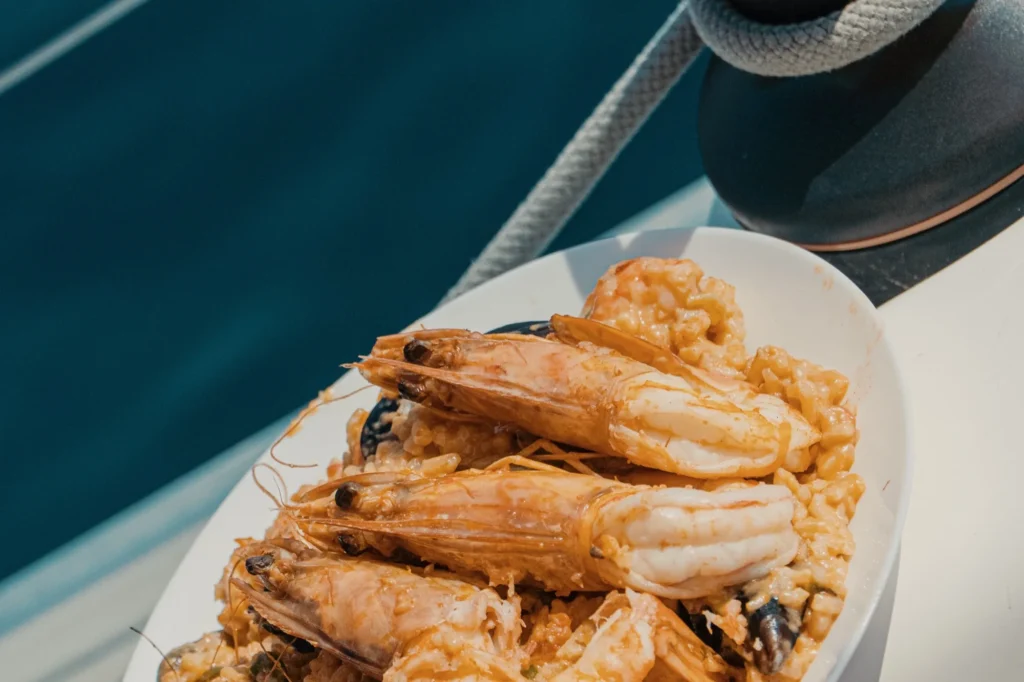
Lunch on board at anchor: simple, fresh and on their own time.
Nothing is fixed. If the children love a bay, you stay another night. That flexibility is the biggest advantage of a private boat over a hotel.
Seasickness: how to avoid it
Short legs. Plan sailing days of one to three hours. Most children are fine on short trips in calm water.
Sail in the morning. The sea is usually calmer before the afternoon breeze.
Stay in the middle and look at the horizon. On deck, not in the cabin, with fresh air. On a catamaran there is much less movement.
Eat light. Crackers and fruit before sailing, not an empty or very full stomach.
Ask your pharmacist. There are remedies suitable for children. Ask before you travel, not on the boat.
What to pack
Pack in soft bags, not hard suitcases: storage on a boat is in lockers and under bunks. Bring less than you think.
For the sun. Mineral, ocean-friendly children’s sunscreen, hats with a strap, sunglasses and UV swim shirts.
For the water. Their own mask and snorkel that fits, water shoes for rocky beaches, armbands for the youngest.
For the boat. Non-marking shoes, a light jacket for the evenings, a small torch.
For quiet time. Card games, a book, a sketch pad. You will be surprised how little they miss their screens.
From home. Favourite snacks, any regular medicines and a small first-aid kit for scrapes.
Insider tips for a family sailing week
Start in a harbour town. The first night on the town quay is easier for children than a remote bay: they see the boat as part of the town.
Build in one ‘do nothing’ day. A whole day at one anchorage with no sailing. It is often the day they remember most.
Bring a small net and a bucket. Small fish and crabs around the boat keep younger children busy for hours. Look, then let them go, and mind the sea urchins.
Give them a job. Helping with the fenders, the lines or the anchor makes children feel part of the crew.
Provision once, well. Ask for a provisioning list before the trip so the fridge is full of what your children actually eat.
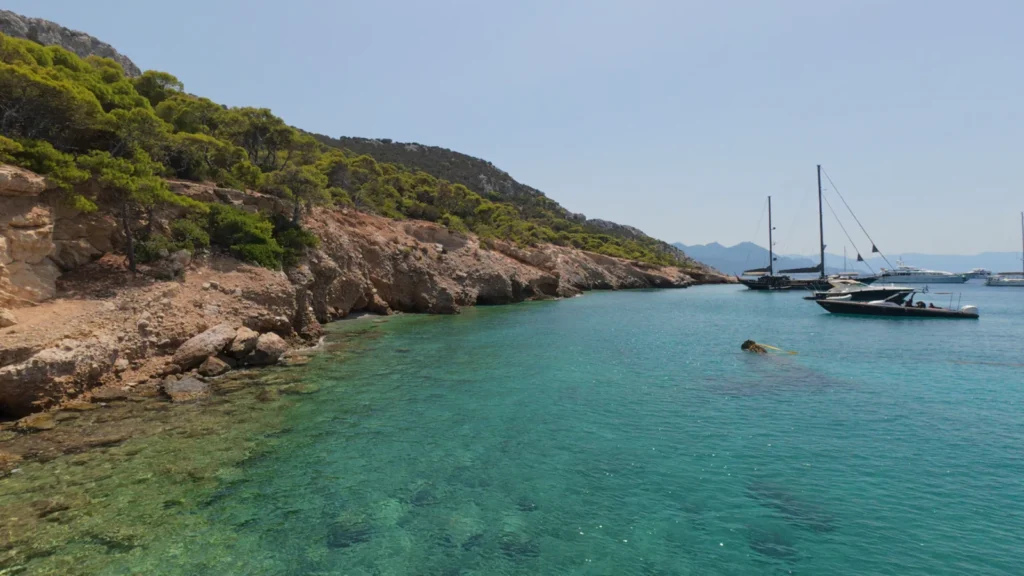
A quiet morning at anchor in the Saronic Gulf.
Questions families ask
What is the best age to sail with children?
Any age can work. Many families find it easiest from about three or four, when children can swim with armbands and follow simple rules. Teenagers usually love it.
Can we sail with a baby?
Yes, many families do. Choose a catamaran, short distances and a sheltered area like the Saronic Gulf, and bring what you need for sleep and shade.
Do we need sailing experience?
No. With a skipper on board you don’t need a licence or any experience. You can help as much or as little as you like.
How long should a family sailing trip be?
A week is ideal: enough time to settle in and slow down. Shorter trips work too if you stay in one area like the Saronic Gulf.
How much does a family sailing holiday cost?
It depends on the boat, the season and how many people are coming. This guide explains what affects the cost.
Keep reading
Sailing Aegina · harbours, Moni island and easy swim stops
Sailing Poros · the most sheltered water in the Saronic
Catamaran vs Monohull · which boat suits your family
Sailing the Saronic Gulf · the best islands close to Athens