It is the first real choice you make when planning a sailing holiday: two hulls or one? Both are great boats. They simply give you a different holiday. Here is an honest comparison, so you can choose the one that fits your group.
The short answer
Choose a catamaran if: you want space, comfort, privacy and a boat that stays flat
Choose a monohull if: you want the classic sailing feeling and a more budget-friendly option
Families and first-timers: usually happier on a catamaran
Couples and keen sailors: often love a monohull
Space and layout
This is the biggest difference. A catamaran has two hulls joined by a wide deck, so everything is on one level: a large cockpit, a saloon with big windows and a galley looking out to sea. The cabins are down in the hulls, split between the two sides and away from each other, which gives couples and families real privacy. At the front there are nets (the trampoline) to lie on above the water.
A monohull is narrower and you go down a few steps into the saloon. It feels cosier, more like a classic yacht. Cabins are closer together, and the cockpit is the heart of life on board. For two to four people it is plenty; for six or more adults it can start to feel tight.
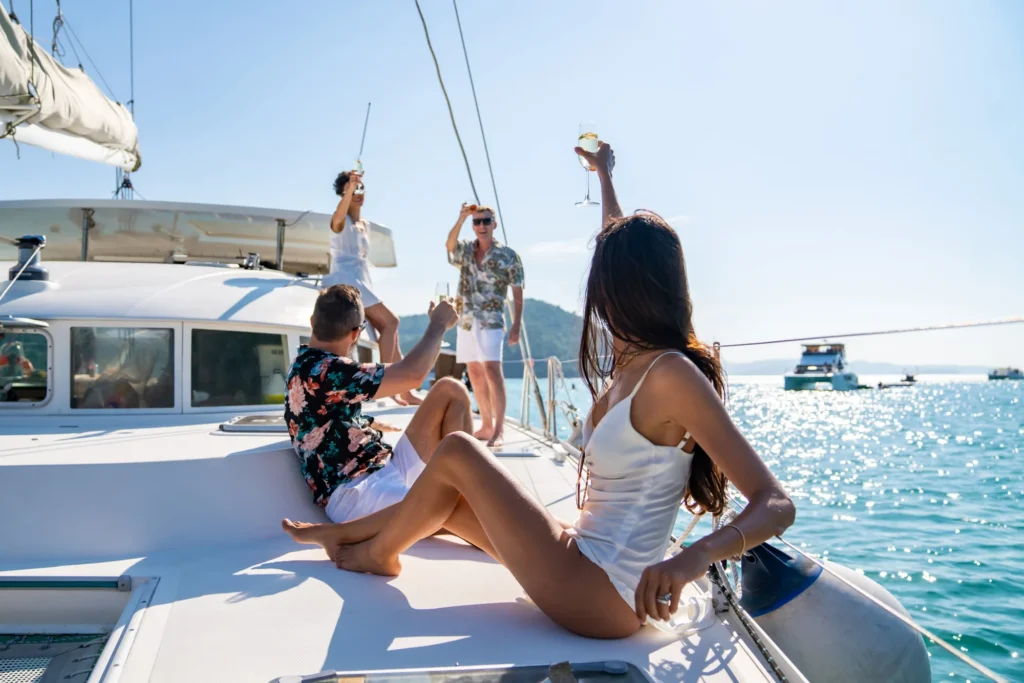
The wide, flat deck of a catamaran: room for everyone.
Skipper’s note: Count bathrooms, not only cabins. On a catamaran each cabin often has its own. On a monohull of the same length you may share two between four cabins, which matters more than people expect.
Stability and seasickness
A catamaran barely leans (heels) while sailing. Glasses stay on the table, you can walk around easily, and people who worry about seasickness usually feel much better. At anchor it also rolls less when a swell comes into the bay.
A monohull heels with the wind. For many sailors that is the whole point: the boat leans, the water rushes past, and you feel every gust. For others it is uncomfortable. If anyone in your group is nervous about the sea, a catamaran is the safer bet.
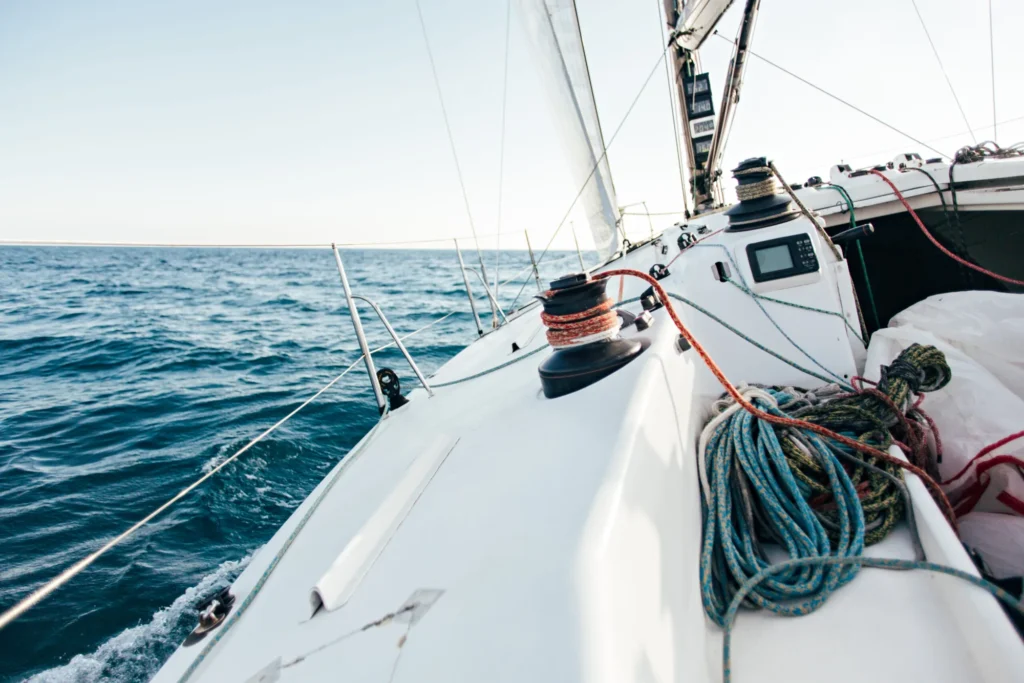
A monohull heeling under sail: exciting for some, too much for others.
The sailing feeling
If sailing itself is what you love, a monohull wins. It points higher into the wind, responds to every touch of the wheel and gives that classic feeling of a yacht cutting through the water. Catamarans are quick with the wind on the side or behind, but they don’t sail as close to the wind and feel more like a floating home than a sports car.
Skipper’s note: In the Cyclades in July and August the meltemi can blow hard from the north. A good skipper plans the route so you sail with the wind rather than against it, whichever boat you choose.
Anchoring, beaches and shallow bays
Catamarans draw less water, often around 1.2 to 1.5 metres compared with about 2 metres for a monohull of similar size. That means you can anchor closer to the beach, and the swim platforms at the back of both hulls make getting in and out of the water very easy. For a holiday that is mostly swimming and lazy bays, this is a real plus.
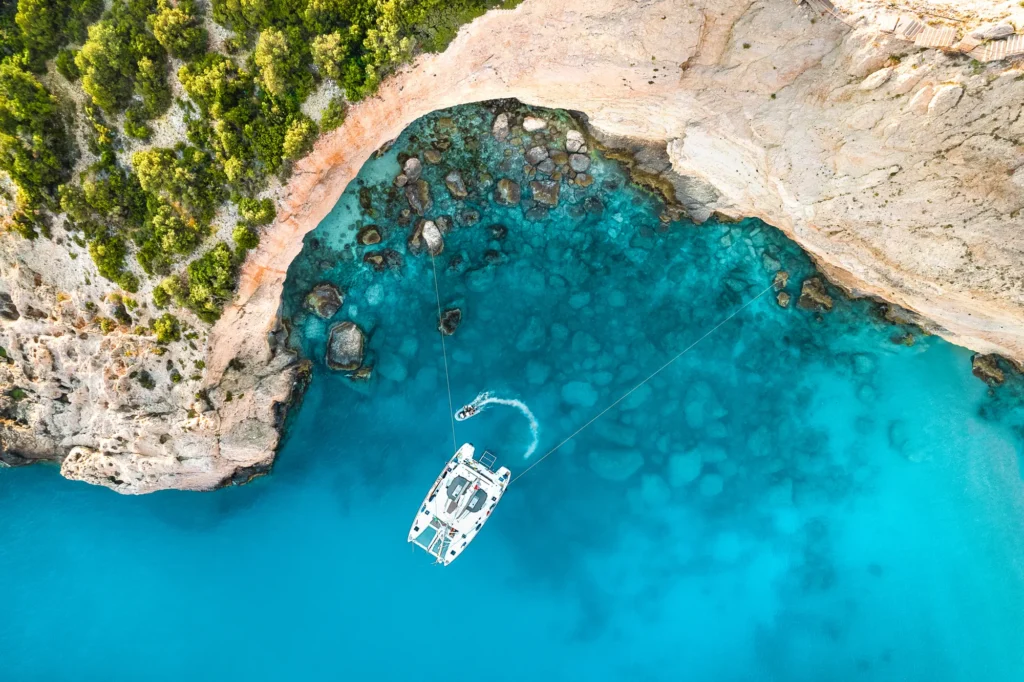
A catamaran at anchor in turquoise water: shallow bays are where it shines.
Harbours and marinas
In Greece you usually moor stern-to on the town quay, side by side with other boats. A catamaran is almost twice as wide, so in small harbours in high season it can be harder to find a space, and some marinas charge more for it. A monohull slips into tight spots more easily.
Skipper’s note: On busy islands in July and August, plan to arrive in the early afternoon. The late arrivals get the outside spots or have to anchor off.
Cost
For the same length, a catamaran usually costs more to charter, uses more fuel (it has two engines) and can cost more in marinas. But it also carries more people comfortably, so for a group of six to eight the cost per person can end up similar. For a couple or a small family, a monohull is usually the more budget-friendly choice. There is more on this in what affects the cost of a sailing holiday in Greece.
Which boat for which group?
Couples. A monohull for the sailing and the romance of a classic yacht; a catamaran if comfort and space come first.
Families with children. Usually a catamaran: flat, safe, lots of space and easy swimming. See sailing in Greece with kids.
Groups of friends. A catamaran, for the cabins with their own bathrooms and the big deck for long lunches.
First time on a boat. A catamaran, especially if anyone worries about seasickness.
Keen sailors. A monohull, every time.
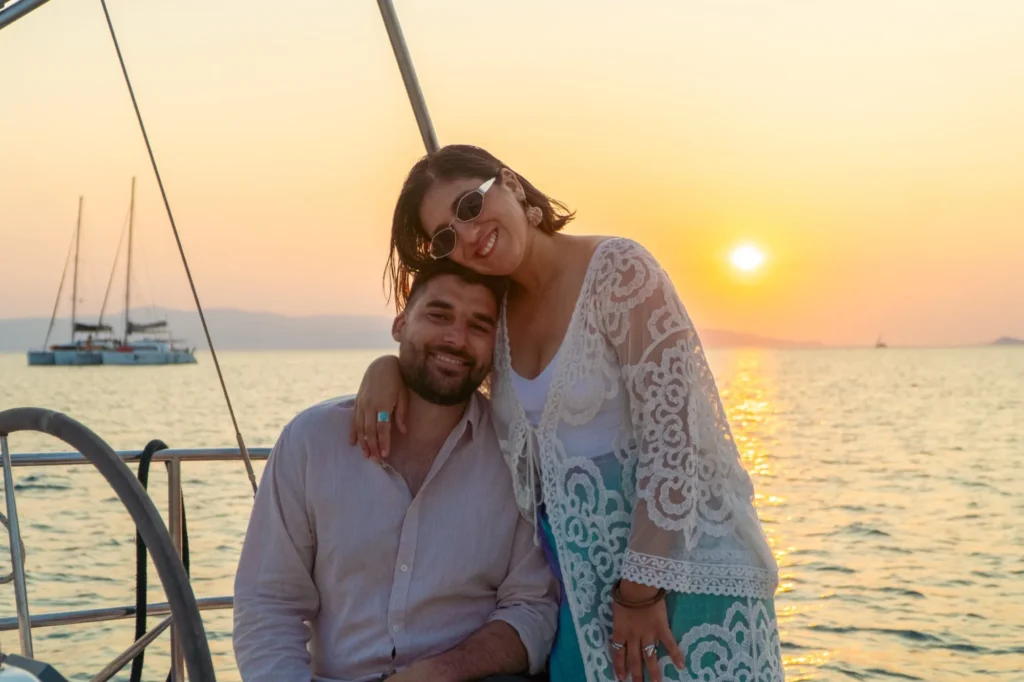
Whatever the boat, the evenings on deck are the same.
Insider tips before you choose
Look at the year, not only the size. A newer, smaller boat is often nicer than an older, larger one.
Ask about the extras. Air-conditioning, a generator, a watermaker or a paddleboard make a big difference in summer. Not every boat has them.
Think about the skipper’s cabin. On many boats the skipper sleeps in a small forward cabin. Check where, so you don’t lose a guest cabin.
Match the boat to the area. In the sheltered Saronic and Ionian either boat is easy. In the windier Cyclades a well-sailed monohull or a solid catamaran both work, with the right route.
Questions people ask
Is a catamaran better for seasickness?
Yes, in most cases. It doesn’t heel and it rolls less at anchor, so people prone to seasickness usually feel much better.
Is a catamaran safer than a monohull?
Both are safe boats when sailed by a professional skipper in the right conditions. They are simply designed differently: a catamaran stays flat, a monohull heels and rights itself.
How many people fit on each?
A typical charter monohull of 12–14 metres sleeps six to eight, though six adults is the comfortable maximum; a catamaran of similar length sleeps eight to ten, with more space per person.
Do I need a licence?
Not with a skipper on board. Read how to plan your first sailing trip in Greece.
Keep reading
Sailing in Greece with kids · where to go, safety and what to pack
What affects the cost · boat, season and extras explained
Sailing the Saronic Gulf · easy islands close to Athens